

Liz Speaks Podcast
To start off, I appeared on Liz Speakman’s podcast, Liz Speaks, to discuss the Massachusetts Public Records Law. Liz’s main guest was Scotia Hille of Act on Mass, an organization that advocates for greater transparency and accountability on Beacon Hill and a state government more responsive to the public.
Act on Mass knows the Public Records Law particularly well because Massachusetts has an unusual transparency problem: the Legislature and Governor’s Office are largely outside the reach of the law. The organization argues that this lack of transparency makes it difficult for residents to know how decisions are being made—or even how their own representatives are voting. Bills can quietly die in committee without a recorded vote, leaving constituents with no clear way to know who supported them, who opposed them, or who should be held accountable.
Their larger point is a simple one: when the public cannot see what its government is doing, it becomes much harder for the public to influence what its government does.
This week’s main course.
Last week, we examined how three Quincy public records requests took three very different paths through the Massachusetts Public Records Law. One of those stories has now reached its next chapter.
When I published RECORDing in Progress: Who Owns the Masters?, one of the requests discussed in the article was still unresolved. Readers of last week’s article will remember this one as “Story #1.”
I had asked the City of Quincy for records showing how much taxpayers were spending on outside counsel in the Quincy Citizens for Fair Raises ballot petition litigation. Rather than requesting legal strategy or confidential communications, I sought administrative and financial records such as invoices, payment records, engagement agreements, and related documents.
The City denied the request in its entirety.
City Solicitor James Timmins asserted:
“The City will not be producing any records responsive to your request below, as
this matter remains in active litigation and the records involve communications
among counsel regarding mental impressions, trial preparation and related
communications protected by the attorney-client privilege. In making this decision, I
am applying Exemption (d) to the Massachusetts Public Records Law.”
My appeal argued that while portions of some records might properly be withheld, the City had not explained why every requested record was exempt or why non-exempt portions could not be produced through redaction.
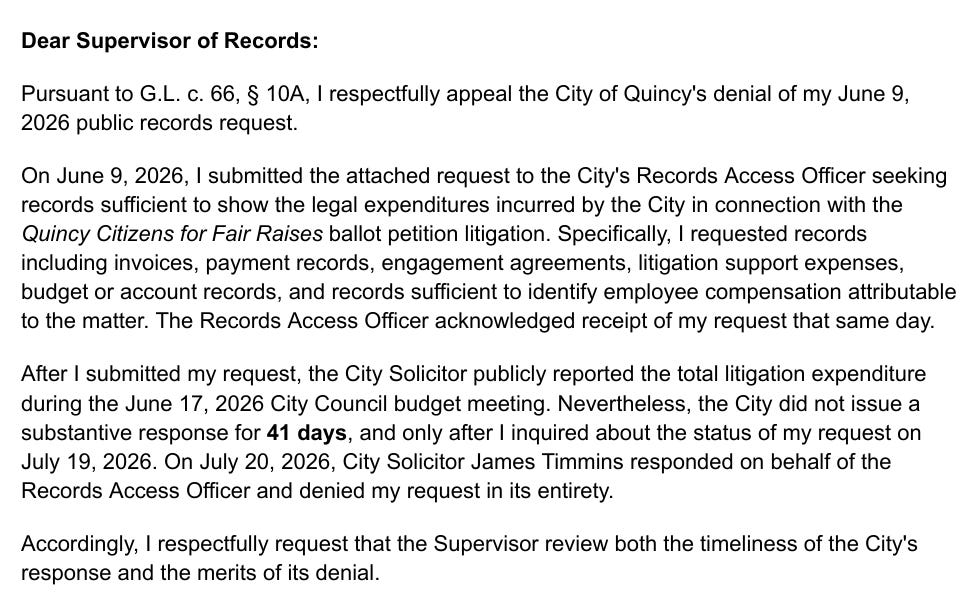
Earlier this week, the Massachusetts Supervisor of Records issued its determination.
The Supervisor’s Decision
The determination focused on the same simple, common-sense principle my appeal focused on. The Supervisor concluded that it was unclear how all of the requested records could be withheld in their entirety and found that the City’s response had not adequately explained why each claimed exemption applied. The determination also noted that when asserting attorney-client privilege, the City had not provided the detailed information required by law regarding the withheld records. The City was ordered to issue a new response within ten business days.
In other words, the Commonwealth did not reject the possibility that some records could be withheld. It rejected the City’s explanation for withholding all of them.
The City’s New Response
The City responded the next day, and its revised response looked very different from the original.
Instead of a blanket denial, Quincy produced:
engagement letters,
contracts with KP Law,
invoices,
payment information,
and a detailed privilege log identifying each redaction and the basis for withholding it.
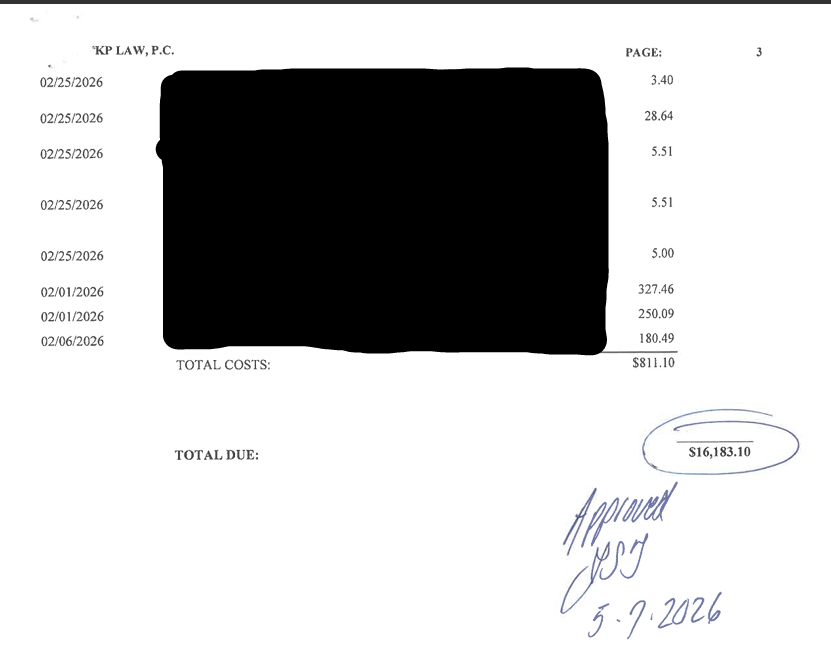
But the invoices now reveal billing dates, hours worked, monthly totals, payments, and the contractual terms governing the City’s retention of outside counsel. They also disclose that KP Law’s lead attorney billed at $360 per hour under the October 2025 engagement agreement.
That is a substantial amount of information the City had previously said it would not produce.
When Timmins updated the City Council on June 17, he reported that the litigation had cost taxpayers $110,847.29. The newly released records show exactly where that figure came from: it was the total of KP Law’s invoices through the end of February, when closing arguments were held. The meter did not stop there. Additional bills for May and June bring the documented cost through June 30 to $118,054.65.
Why This Matters
One of the themes of last week’s article was that winning an appeal does not necessarily mean receiving the records you requested.
That remains true.
The Supervisor did not order the release of privileged communications or litigation strategy.
What happened instead illustrates how the Public Records Law is designed to function when a denial is challenged.
The appeals process required the City to take a second look at its response, justify its claimed exemptions with greater specificity, and separate records that could be released from information it believed should remain protected.
The result was not an all-or-nothing outcome.
It was a more tailored response.
What We Know Now
$360 — hourly attorney rate
$118,054.65 — documented payments through June
$48,936.90 — January invoice alone
159.6 — attorney hours billed in January / 368.3 attorney hours in total.
$3,502.65 — expenses beyond professional fees
$1,160.73 — largest individual expense shown, with its description redacted
0 — how much of this information the City’s original response offered to disclose
A Lesson for Future Requesters
Public records appeals are sometimes dismissed as symbolic exercises that produce little more than another letter. This determination demonstrates they can accomplish much more.
More importantly, the appeal process should not be thought of as an extraordinary legal maneuver or a “break glass in case of emergency” remedy. It is an extension of the public records process itself. For residents who regularly use the Public Records Law to hold government accountable, appeals will sometimes be a normal part of that process. When a request is denied, goes unanswered, or produces a response that does not appear to satisfy the law, asking the Supervisor of Records to review it is simply the next step available to the requester.
When dealing with local government, it can sometimes feel as though City Hall is an untouchable fiefdom, free to do what it wants so long as nothing becomes overly egregious. The Public Records Law provides an important check on that feeling by giving requesters access to independent review when they believe the law has not been properly applied.
A requester may not receive every record sought. But a successful appeal can require a public body to reconsider its response, explain its legal position more fully, and disclose records that were previously withheld.
That is exactly what happened here.
Accordingly, the City is ordered to provide Mr. Murphy with a response to his request, provided in a manner consistent with this order, the Public Records Law, and its Regulations within ten (10) business days. A copy of any such response must be provided to this office. It is preferable to send an electronic copy of the response to this office at pre@sec.state.ma.us. Mr. Murphy may appeal the substantive nature of the City’s response within ninety (90) days. See 950 C.M.R. 32.08(1).
In this instance, that process transformed a blanket denial into the release of contracts, invoices, payment records, and other financial documents that help taxpayers better understand how public money was spent. While some redactions remain, the appeal gave Quincy residents substantially more information than the City originally intended to disclose, allowing taxpayers to more fully assess both the costs of the litigation and the value they received in return.